"On the frontier of Sweden and Norway there are lofty mountains called Dovre-fjell and others like them, which in wintertime are covered in such dense, deep snow that it is quite impossible for travellers to find a firm route over them in the usual way. Yet, to overcome a difficulty of this sort (by their ingenuity) and skilfully lighten their loads, the traders of those parts fasten to their own and their horses' feet wickerwork shoes, or light, broad half-circles of cork or lime bark and, even though they are weighed down with a heavy burden, tread the ridges of snow without fear of sinking...at night, when the moon gives a brilliant light...by the reflection of the white surface, the shimmering brightness illuminates the elevated and sloping snowfields, so that they may pick out from far off the mountain precipices and harmful beasts that have to be avoided...A still greater danger overhangs travelers among mountains that are full of caves, for through the concentration of tiny snowflakes there one can observe the blasts and gusts of wind roused to such violence in those places that, unless they bring along shovels or ice picks with which to clear the way, they have hardly any hope of emerging from mountains so high and valleys so deep."
Tuesday, May 14, 2013
Snow Shoes


Sunday, May 12, 2013
Bulky Fittings

I'm replacing all plastic fittings with metal; the problem is that without custom fittings the assemblies--like this suit automatic overpressure dump valve (silver cap on pipe extending right) and the manual dump valve (black knob)are very bulky, obviously not suitable for flying, only for testing. But the testing is done! It's time to build the flying system! So I need access to a few lower-profile fittings; working on assembling them this coming week, knocking off items on the 48-point To Do list with a laser focus on a good test this summer in Copenhagen.
Wednesday, May 8, 2013
Multi-Planet Species
1 / FAR OUT= working with the research group Icarus Interstellar, specifically Project Hyperion, to provide humanity with the option to voyage to distant planets by the end of this century (they're doing propulsion physic; I'm working on the population genetics).
2 / CLOSER IN = working with the Mars Society on human settlements on Mars, as a stepping-stone to interstellar voyaging.
3 / EVEN CLOSER IN = working on life-support systems, specifically the space suit & life-support machinery for Copenhagen Suborbitals' private space-access project.
And spreading humanity universally is not an escape from Earth but an insurance policy for civilization and our species. I love archaeology, and the human past; but there is also a human future, and I'm working on that in the somewhat longer-term than the usual political or even human-life time-spans.
Monday, May 6, 2013
Pirates of Ancient Britanny!
"Shipwreck, far from terrifying to them, to them is training. With the perils of the sea they are not merely acquainted, they are familiarly acquainted...they gladly endure dangers amid billows and jagged rocks in order to achieve a surprise."
From p.15 of Wooding, J.M. 1996. "Communication and Commerce Among the Western Sea Lanes AD 400-800. British Archaeological Reports, International Series 654.
Sunday, May 5, 2013
Yet Another Pressure Test
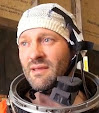
 This pressure test included Alexander Knapton (to my right), Ben Wilson(a little down the line), and Ben Robbins, who shot some great video of the test. Some impressions:
"Having Ben Wilson get in the suit and pressurize, and breathe through the various systems, so that I can see it from the outside, is a revolutionary step ahead. Luckily Ben is a very level-headed guy in the suit. He is a mountaineer, like I was for a decade, and he is happy to engage some danger in the pursuit of something larger.
Huge progress last few weekends. Now a big change to put a laser focus on preparing for the altitude chamber test in August; that means a new To Do list, which I will build this week. This is what a DIY space program looks like :) We lose suit comms every time the suit is pressurized, something to do with mike and earpiece diaphragms being deformed by increased pressure in the suit. In the photo I'm visually confirming with Ben that all is A-OK, using SCUBA sign language. Also a photo of me in the suit, Ben standing by and Nicholas monitoring the webcam and talking with me on radio."
Friday, May 3, 2013
The Gales
"The gales brought us here. They picked us up from the reef out at sea, they tossed us and rolled us and pushed us up high on the sandy head and now we lie here in the sun."
-- Oodgeroo Nunuccal, Australian aboriginal poet, Queensland.
Wednesday, May 1, 2013
'The Lost Raft' by John. F. Haslett

My buddy John F. Haslett, skipper of our sailing vessels off the Pacific Coast of South America, has re-released his book in a Kindle edition! This is a great read that John has packed with information about the original sailing cultures of Western Ecuador, and why Thor Heyerdahl's famous expeditions were simply wrong in their premises, sailing destinations and even building methods. Great reading! I am so proud of my friend, John, for finally putting these tales to paper--not nearly as easy as it sounds!
“Haslett’s two most important characters are the sea and the raft, and they come alive on almost every page." –Publisher’s Weekly
“Haslett’s prose vibrates with energy … [he] makes you feel the lash of the sail and hear the breakers exploding against the rocks … This is a loud, insistently physical read … ” –San Francisco Chronicle
"Haslett’s narrative begins with the launching of a thirty-five thousand-pound balsa raft, the Illa-Tiki, and then follows up by thrusting the reader into life on the Pacific Ocean. Over the next five years the author and his crews alternate between living aboard primitive rafts and being marooned in alien worlds." -- St. Martins Press