Friday, May 28, 2010


Tuesday, May 25, 2010
Monday, May 24, 2010
Book Synopsis
Synopsis; a little more technical than I wish to convey in my book, but the essence is here. Contract signed after six months of wrangling (and with a different title from that below); now to write it, due in April 2011 for publication a little later that year;
Distant Lands Unknown
A Glimpse of a Human Future Beyond Earth

Book Synopsis
© 2009 Cameron M. Smith and Evan T. Davies
For Praxis Publishing, UK
23 November 2009
808 words

The time has come for humanity to begin the interstellar migration, and this book explains why space colonization isn't about rockets and robots, it's about humans doing what we've been doing for four million years; finding new places and new ways to live.

For centuries, authors and dreamers have mused on travel to the planets and the stars, even proposing the human colonization of space, and each justifying this audacious venture in a different way; space colonization would relieve conflict stemming from overcrowding on a finite world; it would lead to a better understanding of our universe; it would foster technological benefits; it would protect our species from any single Earthly calamity. The reasons to go are many.
But mention “space colonization” and many roll their eyes, arguing that it’s a technocratic program focused on rockets and robots, or that it's unrealistic, unnatural, too expensive or technically “impossible”—or that we must sort out our problems on Earth, first.

Distant Lands Unknown—an anthropological perspective on human space exploration and colonization—argues that on the contrary, space colonization will be a natural continuation of our species' four-million year legacy of adaptation to difficult new environments, that human innovation has often built reality from “impossibility”, and that staying on Earth will eventually cost us everything.

Serious calls for human space colonization began with Konstantin Tsiolkovski's early-20th century musings on a peaceful and bountiful human expansion “out of the cradle”, that is, off of Earth. Tsiolkovski’s ideas were in great contrast to the outer-space books of the Space Race era, which carried a competitive, nationalistic, and technocratic tone. More human-centered space colonization books appeared in the 1970’s and 80’s, including Gerard K. O'Niell’s popular-science hit, The High Frontier. But since that time, no book on space colonization has been a real popular-science hit, mainly because they use worn-out sloganeering, sentimentality, conceptions of destiny, and intimidating technical jargon that alienate the very mass audience they wish to engage.

In contrast, Distant Lands Unknown is written accessibly and engagingly for the widest audience possible, humanizing space colonization. The authors discuss the history of human adaptation and technological innovation, put people in charge of the machinery of spaceflight (rather than the other way around) and contextualize space colonization as a continuation of human evolution at large.

The authors begin by reviewing human evolution, emphasizing proactive adaptation as a distinctive feature of our lineage in contrast to the reactive nature of the evolution of every other species. Next, they illustrate that humanity has been actively expanding geographically for the past four million years, specifically via three adaptations: (1) tool use to augment anatomy, (2) cognitive complexity and language, and (3) the development of agriculture and occupational specialization.
Drawing on examples from the four-million year history of human adaptation to new environments, the authors argue that human settlement beyond Earth would be a continuation of the adaptive history of our lineage, demonstrating that we have done this before, and we can do it again.

The authors highlight three thrilling tales of human colonization; the migration of human ancestors out of Africa, the prehistoric colonization of the Pacific islands and the settlement of the high Arctic. In each of these cases, humanity adapted to new, hostile environments with everything from novel social customs to new technologies including voyaging canoes and igloos. We reason that these inventions were as critical to survival as any astronaut's space suit.

Next, the authors review what humanity has learned about our solar system to date. The authors suggest that, as Carl Sagan once remarked, we have put one foot into the waters of the cosmic ocean; now, will we continue in, or will we retreat? The authors convey the wonders and dangers that await humanity in space with prose that immerses the reader in cosmic grandeur and the adventure of discovery.

The authors show how this is everyman's journey—not only the domain of the engineer and rocket scientist. From the Inupiat colonization of the Arctic to walking on the Moon, humanity has been exercising our fundamental evolutionary instinct to explore and expand. Our history and prehistory have prepared us for the final and grandest episode of adaptation; building self-sufficient human colonies beyond Earth.

Having humanized space colonization and shown why it is critical to human survival, Distant Lands Unknown concludes with a review of concepts for extraterrestrial colonization, including the settlement of Mars and some of the moons of our largest planets. Based on the most current understandings of our universe and the most recent technological breakthroughs, we at last offer a glimpse of a possible human future involving interstellar travel and settlement of worlds beyond our own. In the end, Distant Lands Unknown argues that space colonization is a good idea for humanity, and that this adaptation can be done; after all, we’ve been doing it for four million years.
Sunday, May 23, 2010
Chiu Liang Kuo is Still Alive
Email from Chiu, back from a month without communications in the Arctic:
Hi Cameron,
I am still alive.
I just arrived home.
Many weeks are in storm there, unusual weather for Pond in the Apr.
Anyway, I talk to you later.
Cheers,
Chiu
Friday, May 21, 2010
Tonight's Work

Connected the helmet, with its recently-installed oral-nasal mask (ONM), to the A-14 regulator, although the regulator wasn't connected to a pressurized breathing gas supply. Still, a useful exercise to see the ONM working inside the helmet and starting to get a feel for the helmet, breathing gas management system and flight performance monitor panel all working together. Getting used to using the system makes it, bit by bit, less mysterious and exotic; which is good, as it all needs to be done so many times that in flight these movements are automatic.
Once the pressure suit and life support system is built, I'll start building the actual flying seat and the very limited gondola that will be suspended beneath the balloon. Everything builds out from the pilot in his seat, so the suit and life support system are first; the balloon to take all of this to 50,000 feet will be the last thing I build. Sewing a balloon is laborious but not complicated; two builders recently built a balloon of roughly the size I'll need over the course of a few weekends. Sewing fabric panels into a balloon of the size I need requires a 20-foot long seaming table, and there's just room in my living space to build that table when the time comes. For the moment, though, plenty of work just on life support and the seat / gondola (balloonists for some reason hate the term 'gondola', preferring 'car', and I'm interested to know why...but for the reason I prefer 'gondola' or better yet 'ship'--and it will be, at least in my eyes, a magnificent ship!).
Aranjuez concerto and New Life
'Space music' by Isao Tomita; an interpretation of Juan Rodriguez's 1939 masterpiece, the Aranjuez concerto.
And a note on the first production of synthetic life. I think this is a spectacularly bad idea. Since January I've read over 300 journal articles, books and papers on the cutting edge of modern evolutionary biology in research for my forthcoming book on evolution, and the clearest message of all is that there are several major paradigmatic shifts going on, right now, in the life sciences, particularly in microbiology. That tells me that we are still just sorting out the principles of genetics, and that introducing new life into the world is foolish and reckless. Of course these life forms will escape the lab; Venter and his associates have even planned for that by writing a 'fingerprint' into the DNA so it can be identified later, so I can't be told that even they are confident of confining this synthetic life. Bad idea, guys. Remember the nuclear genie, of which--with, say, the prospect of London incinerated by a nuclear blast--we now think, Gee, wish we hadn't let that one out of the bottle? Remember that?
Thursday, May 20, 2010
Oral-Nasal Mask Installed

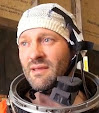
This component has given me more difficulty than any other in the project so far. For a number of reasons, I've decided to use an oral-nasal mask inside the pressure helmet; building it in has been difficult because the mask--until I heavily modified it--was too big to fit inside the helmet. Also, routing breathing gas intake and exhalation hoses has been comically difficult--it seems so easy, but half a dozen factors make it hard to do. I spent a month on the gloves, but now I'm into the second month of this component. The mask is in, now, as you can see above...but to be honest, it still isn't right; it's a little too tight, and the intake/exhalation hoses are too small, making breathing slightly more laborious than usual...and I just can't have that. So, while this is close--no cigar! More modifications are in store. I might even devise a system that ditches the O-N mask altogether, which would be preferable.
Subscribe to:
Posts (Atom)