Sunday, May 29, 2016
Steep Learning Curve!
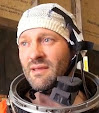
We are learning a lot, and quickly, and moving very rapidly toward building the final high-altitude pressure suits...today Mathew l. and I fabricated two helmet mounting rings to work with our new, lightweight 'soft helmet'. More frequent updates are on the Pacific Spaceflight twitter account.


Saturday, May 28, 2016
Silent Film of Pressure Suit Test!
Here is some silent video of a pressure suit test, I am in a Bell Jet Ranger helicopter going to just shy of 20,000 feet, but the suit is giving me pressure--through the 45-minute flight--that fooled my body to think that it was at just 11,000 feet! The suit held pressure, dumped my exhaled C02, maintained a good temperature, and gave me enough mobility to work the controls! All A-OK!
https://www.youtube.com/watch?v=ZVtVPJUjSEo
Monday, May 23, 2016
Authorship
"The design of a book is the pattern of a reality controlled and shaped by the mind of the writer. This is completely understood about poetry or fiction, but it is too seldom realized about books of fact. And yet the impulse which drives a man to poetry will send another man into the tide pools and force him to try to report what he finds there..."
-- John Steinbeck
Friday, May 20, 2016
Developmental Biology and Human Space Settlement
Today I had occasion to work on a diagram addressing some reproductive issues in the prospect of human space settlement. In particular I feel that early developmental biology will be most likely to be upset by conditions different from Earth's one-g gravity field, which has shaped land animal reproductive biology for over 300 million years. This October, Elon Musk will reveal SpaceX's plan for a city on Mars. I say Bravo! Bold and important! But we will need to learn a lot about our biology on Mars, where 1/3 gravity of Earth will be sure to affect reproduction; and we may have to ensure the health also of our domesticates, plant and animal, who will accompany us to the Red Planet as well! All good reasons to begin research and planning now, as I'm doing in my forthcoming graduate-level technical book "Principles of Space Anthropology".

Saturday, May 14, 2016
Immersion Test Photo
A recent immersion test; only the smallest leak from the helmet is visible as tiny bubbles rising from a fitting that just needs a little tightening; the rest of the bubbles are from safety divers. We learn a lot from every test, and so far I've spent 2.2 hours submerged in our various pressure suits!

Wednesday, May 11, 2016
Serial Explorer
This article in the June 2016 'Men's Journal' describes me as a 'serial explorer by nature'. That's OK with me.

Tuesday, May 10, 2016
H.J. Muller's 'The Uses of the Past'
I'm reading the most exciting and challenging book I have read for some years, HJ Muller's 'The Uses of the Past' (1952). Muller is a dispassionate historian commenting on the state of 'civilization' at his time, colored of course by his experience of WWII, but still remarkably separated from that catastrophe. His encapsulations of Greece, Rome and the Enlightenment are rich and erudite -- every few pages take me a few days to digest. Highly recommended (for those who can extract themselves from the navel-gazing present)! One passage:
"Science remains the author of our major problem, in its gift of tremendous power that has been terribly abused; but for the wise use of this power we need more, not less, of the objective dispassionate scientific spirit. For our philosophical purposes we need more of its integrity and its basic humility, its respect at once for the fact and the mystery."
"In short the Greeks were cribbed and cabined by their ideal of excellence...they lived in a tidy Euclidean world, finite, static, complete. They had no feeling for horizons, prospects or backgrounds, [having] such a horror of infinity that the idea was taboo...their colonies clung to the Mediterranean...Their ideal of excellence was a design for living in this small world, and included elements unsuited to our life as the Greek cornices on our early skyscrapers...In particular the city-state was a very small affair, whose administrative problems were negligible...We have not only created great nations but sought to enable the whole population to participate in the whole life of the nation. Now we have set up the idea of a United Nations...We are dealing with problems the Greeks hardly thought of."
And part of a review of one of his later books:
"[Muller argues that] the literary resentment of science is based on the belief that science conceives a universe of brute fact in which the sole principle of explanation is mechanism, in which the conception of human free will is impossible, in which mind is but the passive recorder of events and—perhaps most important of all—in which “values” have no validity. The literary philosophers conceive the alternative to scientific naturalism to be some form of religion, although in practice this is usually no more than a religiosity which takes its chief impulse from the ingrained, unconscious pragmatism of the “believer”—he needs a faith and will have it, for it does him good. At first glance, this literary hostility to science seems the continuation of a crisis in culture which began early in the nineteenth century. In actual fact, however, it is merely the vestige of that historical situation, ritualistically continued and maintaining the appearance of life by feeding on ignorance: Mr. Muller is polite but blunt in saying that literary men of philosophic bent know little about science. What they so courageously defy is the science of Tennyson’s “The Two Voices,” not science now in use." That review excerpt is from this source.
Subscribe to:
Posts (Atom)