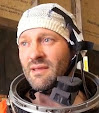
"Hypothermic and dehydrated, I knocked on the door of a windswept cabin at the bottom of the Hoffel Valley. It was opened by a stout Icelander, Hordur of Hoffel, who welcomed me into his warm home, miles from any village. Though the calendar read AD 2000, Hordur's way of life -- shepherding sheep and extracting hardy crops from near permafrost -- made his life materially little different from that of the earliest Icelanders, a thousand years before. The calendar might have read AD 1000."

Monday, November 30, 2015
Hordur of Hofelsdalur
From my book-in-progress about my Iceland expeditions 2000-2004!


Sunday, November 29, 2015
Dry Test
Today's test was 'dry', nobody in the suit; identified a small problem, which I'll fix this week for an upcoming 'wet' test, meaning someone in the suit!

Wednesday, November 25, 2015
Going Up!
Last weekend was spent meeting a balloon inspector in central Oregon, and then checking out various possible flying terrains in sparsely-settled regions of Eastern Washington state. Frigid cold and wide-open landscapes! Photo with Pacific Spaceflight team member Michael Rudis, who is also seen learning the use of a hand-bearing compass (on a small municipal airstrip). Slowly but surely advancing towards flight! We named one possible flying site 'Area 52'.


Friday, November 13, 2015
Iceland Book Illustrations
Slowly but surely, I am editing the book on my Iceland expeditions, and illustrating it. I'm using a white-pencil-on-black-paper technique, which I think effectively communicates the dramatic conditions of the expedition, which, during winter, was mostly carried out in darkness. Here, a fumarole on the ice cap sends up a cloud of steam, some of which freezes into ice crystals that seemed to rain down through the blackness! The hours spent making such a drawing allow me to revisit my time on that great expedition!

Saturday, November 7, 2015
Refurbish!
Tonight I refurbished the old suited person monitor; monitors person in trainer capsule (on left, under spaghetti pile of hoses) with two video feeds, for C02 (new, sensitive gauge donated recently by a local company!), blood oxygenation, pulse, breathing gas tank pressure, suit pressure, various gas flows, various times (with three digital timers), intercom phone & a few others. Very much improved and running 3 laptops, having gone more digital this last year over analog gauges etc. The flying machine will be more analog than digital but for various reasons the laptops are good for testing. Progress!

Monday, November 2, 2015
Exploration
"In exploration, safety is not the most important thing. In exploration the most important thing is to actually go."
-- Wayne Hale, former Space Shuttle Program Manager & Flight Director for 40 NASA missions over 32 years.
Thursday, October 29, 2015
Off to the Printer -- An Adaptive Paradigm for Human Space Settlement
Off to the printer! Since reading "Interstellar Migration and the Human Condition", edited by U Hawaii anthropologist Ben Finney, years ago, I have been working on ideas in the realm of long-term human space settlement; not as flag-planting, or 'the conquest of nature', or an expensive luxury of bored nations, but as a responsible investment in the human future. This article now off to Acta Astronautica, where the message reaches many in the rarefied world of space policy. The point here is to begin assembling an adaptive, evolutionary framework and context for long-term human space settlement. One step at a time!

Acta Astronautica is a peer-reviewed scientific journal sponsored by the International Academy of Astronautics. Content is based on original contributions in all fields of basic, engineering, life and social space sciences and of space technology related to:
The peaceful scientific exploration of space,
Its exploitation for human welfare and progress
Conception, design, development and operation of space-borne and Earth-based systems In addition to regular issues, the journal publishes selected proceedings of the annual International Astronautical Congress (IAC), transactions of the IAA and special issues on topics of current interest, such as microgravity, space station technology, geostationary orbits, and space economics. Other subject areas include satellite technology, space transportation and communications, space energy, power and propulsion, astrodynamics, extraterrestrial intelligence and Earth observations.
Subscribe to:
Posts (Atom)