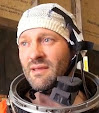
The avalanche of advertising that assaults us daily often uses, in a fragmented, shredded form, some of civilization's greatest achievements. We respond to these fragments because even these bits carry a great freight of two thousand years of our civilization's sensibilities. Here is one, often stripped into parts, that we rarely get to hear in its entirety;
Bach Cello Suite 1.
Monday, October 17, 2011


Tuesday, October 11, 2011
Evolution Talk

A talk I'm giving tomorrow; image placed here for boring, technical reasons...but if you're interested, see you there! The talk is based on recent article, linked here.
Saturday, October 8, 2011
System Pre-Test!


Last night's pressure leak was just a loose connection, and I fixed it this morning. I then connected the electrical system, pressurized the breathing gas / suit inflation system, and turned on the master power switch. All well! The new pressure regulator works beautifully and is much easier to control, right down to even finer than 1psi increments. Pressing the inflator button on the suit worked to send gas to the suit (on the right, with the pressure restraint garment pulled aside from the connection for now) and the electrics turned on a small 'cockpit' light (on a foot-long snake neck) to help illuminate the instruments, and the voltmeter displayed the battery charge. Power is flowing through the main breaker without loss of amps downstream, and the oral-nasal mask breathing system worked to inhale breathing gas from the tank and then purge exhaled gas out the appropriate hose. It all works. Now, back to the last adjustments of the pressure restraint garment, which means more sewing, which I can only do once I get my hands on some large sailmaking needles; I finally broke the last of mine last week. This was the last one remaining from the set that Dad bought for me before the sailing raft expedition back in 1998-1999. So - very close to the full suit test, and I'm looking for people to help with that, which will include one suit manager, one power/gas system manager and one person to shoot stills and video.
But wait! One more component to build -- the suit coolant system, requiring a new fluid pump and sewing the coolant hoses into a special vest. Still -- awfully close, now, to the incredible day when I can demonstrate the viability of this system! Hoo eee! The anticipation is fantastically energizing!
Friday, October 7, 2011
New Pressure Control Unit Installed

After a departmental get-together, I rushed home to build the new pressure controller into the system; it's the unit I'm dialing with my left hand in the photo, the unit with two red hoses coming off of it. All well--until I pressurized the system. There's at least one leak somewhere, and I have to check all the connections. If they're all OK, then it's a defect in the control unit...and I'll move on to fixing that. I'll be on the fix before sunup!
Saturday, October 1, 2011
Pressure Controller

Finally, the new pressure controller arrived. This steps down pressure from the breathing gas tank to the actual breathing regulator. The previous one was a little too fiddly and its intake pressure limit was a little too close to the pressure coming off of the breathing gas tank. This one, though weighing five times more than the smaller one, and more difficult to mount, is far superior, and its overall robusticity inspires confidence. I have to take it apart to be sure there's no grease in the system, as pure oxygen and grease can lead to combustion! Taking it apart and putting it back together, as I do with my SCUBA regulators, will be my best way to really understand how it works. It's better than looking at a schematic diagram, and better than looking at a video clip; nothing is better than carefully inspecting every element as I take it apart and then put it back together.
Saturday, September 24, 2011
Colonists
A draft of something I'll be putting in the space book; not sure where, and it's just a draft (I'll end up editing it, probably, about four times), but there are important points that summarize some of the more important points of the book. Last 50 days of writing and editing now!
(c) 2011 by Cameron M. Smith
"There will always be people who feel that colonizing space will only transport our problems elsewhere. We prefer to be optimistic. The first colonists to arrive at Mars will look down on a world where not a single bullet has been fired, where not a single bomb has ever fallen from the sky. We think early colonists will be very aware of this. They might well prohibit such weapons entirely. Of course, a human being can always kill with their hands; that will not, we think, be solved. And a human being can make a weapon out of nearly any object, or even construct weapons in secret. But in a pristine world, we think, people will be determined not to repeat old madnesses, and they may be extremely intolerant of even the seeds of division, violence, and waste. In ancient Iceland, murderers and other criminals were banished to the wilderness, where life was nearly impossible. Similar rules may be enforced by early off-Earthers. And if things grow the wrong way on Mars--just as they might grow wrong on Earth even if we someday achieve universal peace--there would remain the solution that has been used by various human groups on Earth for millennia: social fission. In many cultures, it has been customary to relieve tensions by splitting up, an option almost impossible on Earth today. The science fiction writer Robert Heinlein wrote that "When things get so crowded that you need an ID, it is time to move. The great thing about space travel is that it has given us somewhere to move." For a long time, Mars will offer large landscapes for expansion; places to go if things turn badly.

And, of course, Mars is no end; one of our points in this book has been that human space colonization cannot be though of as an end, like landing on the moon nearly 50 years ago. Rather, it is a beginning. Eventually, people of Mars might want to move farther on; in fact, considering what we have learned about humanity in this book, that seems natural and inevitable, while challenging it seems unnatural. We feel that other places in the solar system, and eventually the galaxy, and eventually other galaxies, will all be explored, and some settled. Humanity, by this method of continual expansion, will have aligned itself with the nature of the universe, which is change. There is no utopia, because conditions change, and humanity itself changes. If there is a constant it is change and the evolution itself that adapts to that change. But for humanity to engage with this reality, we have to begin somewhere, and we argue that we should begin now. There will never be a best time to begin; it will always be argued that we have more pressing immediate concerns. But to focus on those immediate concerns could, in the end, cost us everything. In our daily lives, we invest heavily to protect our future, by buying insurance and minding our doings. Colonizing space will be nothing less than an insurance policy for our species and civilization. It is worth the cost and effort."
(c) 2011 by Cameron M. Smith
Tuesday, September 20, 2011
The Little Engine That...Couldn't

The poor little 3.8 liters per minute, 12vDC pump (small black item on the center testbed support) that I acquired to pump suit coolant through the liner suit just isn't up to the job. In my zeal to get the smallest, lightest and simplest pump available, I shot a bit low. Poor little bugger just whizzed and whined but could barely move the fluid (from the tall, clear cylindrical reservoir) though the coolant hose. I need a more powerful pump, and that's easy to get. This time I'll do a little more homework RE capacity to circulate. Small setback only, though, and again I've learned something.
The idea of the cooling system is simple; cool, non-freezing fluid (maybe antifreeze) is pumped from the reservoir through a port (that I'm holding in my hand), through tubing sewn in the suit liner, and then back out the same port and back into the reservoir. As the fluid moves through the tubing in my liner suit, it should pick up body heat and carry it outside to the very cold atmosphere, where it's cooled again, dumping that heat, before pouring back into the reservoir. I'd prefer a non-battery-reliant system, and I thought about a non-continuous manual pump (just work a lever to pump the fluid), but I figured in that event I'd just build more body heat by doing the manual pumping, so I'll stick with the 12vDC system for the moment. If I can figure out a way to find some 'free energy' based on movement of the balloon or other workings of the system, to pump fluid, great; but I haven't found that energy yet.
Looks like blogger has enabled some picture viewing 'feature' that, when you click on the image to enlarge, brings up a window with a smallish image! So, to see the image full-size, you have to save it to the desktop (on a mac) or right-click to 'view image' (on a PC), after which you click it *again* to see it full-size. Maybe I can turn that 'feature' off...I'll look around.
Subscribe to:
Posts (Atom)