Music from the ITV series, 'The Midsomer Murders', interpreted by Celia Sheen:
Friday, May 7, 2010


Thursday, May 6, 2010
Schematic

Quick image of the gas management system in schematic form; now, with the system sketched out by trial-and-error over the last year or so, I can specify every item in the system; every valve (eight at the moment), gauge (four at the moment), hose, component, connector and tank can now be specified, purchased (I have about half of the needed items), cataloged, weighed, and finally built into the system. This schematic doesn't include the electrical components, but those are going to be very limited; I don't like to rely on batteries, especially at -50F.
Below, a quick description of the system. I am trying to keep it as simple as possible. The fewer components, the safer; then again, backups--I don't have many at this stage--will be necessary, and are, of course, worthwhile.
Life-Support System Gas Management System Schematic Alphanumeric Key
CM Smith
07 May 2010


Tank A=breathing gas
Tank P=suit pressurization gas
Tank R=breathing gas for bail-out

Gasses to be determined. If liquid oxygen is to be used for breathing gas, extra components will be added.

Breathing gas for the pilot is delivered from tank A at c.3000PSI (monitored at gauge G1) through first-stage regulator A1 (controlled by valve V1) to a pressure-reducing valve (A2,V2), where it is reduced to c.40PSI (monitored at gauge G2). This gas travels through low-pressure hose A3 to a demand regulator (B). The demand regulator reduces pressure to 10PSI and delivers breathing gas via low-pressure hose B1. Breathing gas passes through component B2, a battery-operated gas-warming unit, and B3, a backup warming unit using chemical heating packs. Breathing gas is delivered to the helmet through component C, an inhalation valve (V3) activated by lowered pressure in the oral-nasal mask (D; installed inside the pressure helmet) at each inhalation.

Exhaled gas is motivated by increased pressure in the oral-nasal mask at each exhalation, where it is carried out of the helmet through component E, an overpressure valve (V4) activated at approximately 0.07PSI, the standard increase of gas pressure at normal exhalation into an oral-nasal mask. Exhaled gas travels along low-pressure hose F to a valve (V5, G) that admits exhaled gas through low-pressure hose H into the Exhalation Reservoir (I).

During normal breathing, V5 is open and V6 is closed. When the Exhalation Reservoir is nearly full the pilot (a) closes valve V5 (G) and opens valve K (V6), where low ambient pressure draws Exhalation Reservoir gas from I, through J, V6/K and Outlet Warmer L (a battery-operated warmer to prevent ice-up) and outlet hose M. This Overpressure Dump Procedure can be accomplished by the pilot in a few seconds by (a) closing V5, (b) opening V6, (c) closing V6, and then (d) opening V5. This procedure dumps exhaled gas into the ambient atmosphere. Care should be taken such that (a) the Exhalation Reservoir (I) is evacuated periodically (by the pilot responding to a simple, mechanical alarm, backed-up by a reminder from Ground Control) and that (b) valves V5 and V6 cannot be opened at the same time; this would allow low ambient pressure to evacuate not only the Exhalation Reservoir (I) but also hoses H and F, oral-nasal mask D, the pilot's lungs, and would activate inhalation valve V3 (component C) until valve V5 or V6 were closed. Since this evacuation / depressurization might be lethal, it must not be allowed. A mechanical arm connecting the physical valves V5 and V6 should be designed so that when V6 is open, V5 could not physically be open. Backup valves for V5 and V6 should be built into the system, to be used in the event of failure of V5 and/or V6.

A wrist-mounted pressure gauge (N, G3) indicates suit pressure.

Pressure suit pressurization gas is delivered from tank P at c.3000PSI through a first-stage regulator/valve (P) which reduces pressure to c.10PSI; low-pressure hose P2 admits this gas through a second valve (P2) and into low-pressure hose P3, which delivers it to component Q, a self-sealing quick-connector that admits pressurization gas into the pressure suit bladder.

In the event of bailout, the pilot would (a) open valve V8 (admitting breathing gas into low-pressure hose S), (b) close valve V2, (c) disconnect breathing gas hose B1 from demand regulator B (this hose would self-seal), check suit pressure at gauge G3 and if necessary pressurize the suit with supply from tank P, (d) disconnect self-sealing hose P3 from the suit inlet valve (Q), (e) begin breathing from tank R, and (f) bail out.

NOTES

1. The Exhalation Reservoir Dumping Procedure should be streamlined such that it is accomplished in less than three seconds. Valves V5 and V6 must be in easy reach of the pilot at all times. The procedure must be practiced to the point of 'muscle memory' at the moment of Exhalation Reservoir Dump Alarm.

2. The Bailout Procedure should be streamlined such that it is accomplished in ten seconds or less. The procedure must be practiced to the point of 'muscle memory' at the moment the pilot decides to bail out.

___ END OF FILE ___
The Outer Heavens

As usual, tremendous writing by Antoine de Saint Exupery (photographed above about 1937), this time from 'Prisoner of the Sand' in 'Wind, Sand, and Stars';
"In the profound darkness of certain nights I have seen the sky streaked with so many trailing sparks that it seemed to me a great gale must be blowing through the outer heavens."
Wednesday, May 5, 2010
Increase
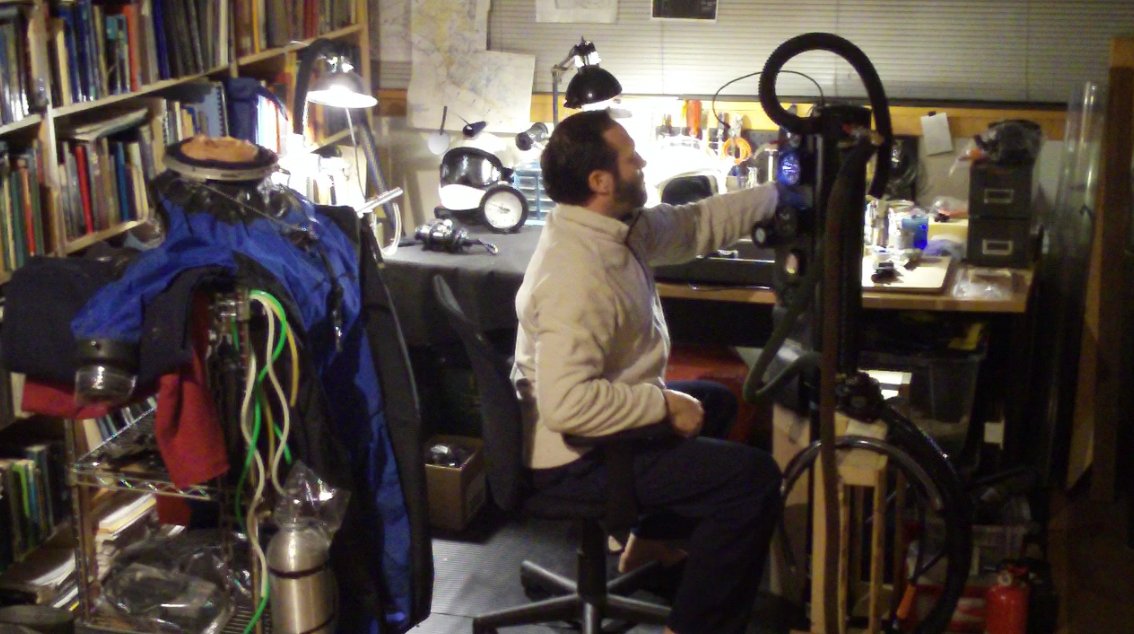
The system is growing; it is claiming territory in my living space, creeping like moss; it is also consuming whole domains of my mind. I swing between moments of despair, when I envision disaster, and a glowing joy, when I accept that I've arrived exactly where I am supposed to be, doing exactly what I'm supposed to be doing.
John Steinbeck, writing about writing East of Eden, told his editor that he could not allow himself that there was anything beyond that book; he was writing it as though it were his last book; and he believed that every book should be written that way. That sounds right because it is how I feel about the stratosphere project; I am not preparing to lose my life, but I am preparing as though this will be the last expedition. Everything I am, to paraphrase Steinbeck, goes into this. There can be no dilutions, no compromises.
Above, the system now growing East away from the building table.
Tuesday, May 4, 2010
Daemon
Regarding the creative momentum that some call the effects of muse, others call associative though processes, others call simply inspiration, Rudyard Kipling--who called it Daemon--wrote;
Rudyard Kipling in Working Tools, 1937.
"My Daemon was with me in the Jungle Books, Kim, and both Puck books, and good care I took to walk delicately, lest he should withdraw...When your Daemon is in charge, do not think consciously. Drift, wait, and obey."Rudyard Kipling in Working Tools, 1937.
Monday, May 3, 2010
Immersion
From "The Naturalist" by Barry Lopez, published in the Autumn 2001 issue of Orion magazine:
"To read the newspapers today, to merely answer the phone, is to know the world is in flames. People do not have time for the sort of empirical immersion I believe crucial to any sort of wisdom. This terrifies me, but I, too, see the developers’ bulldozers arrayed at the mouth of every canyon, poised at the edge of every plain. And the elimination of these lands, I know, will further reduce the extent of the blueprints for undamaged life.

After the last undomesticated stretch of land is brought to heel, there will be only records—strips of film and recording tape, computer printouts, magazine articles, books, laser-beam surveys—of these immensities. And then any tyrant can tell us what it meant, and in which direction we should now go. In this scenario, the authority of the grizzly bear will be replaced by the authority of a charismatic who says he represents the bear. And the naturalist—the ancient emissary to a world civilization wished to be rid of, a world it hoped to transform into a chemical warehouse, the same uneasy emissary who intuited that to separate nature from culture wouldn’t finally work—will be an orphan. He will become a dealer in myths."
Sunday, May 2, 2010
More Checklists

Checklists for everything; for suit donning and suit doffing; for the communications system; for the electrical system; for the life-support system. Can't make a mistake. I have to clean my workspace, too; in the 60's, David Clark company seamstresses, who built the space program's pressure suits, cataloged every needle in their work area. Get with it, Cameron! A metal shaving in the wrong place today could be catastrophic a year from now.
Above, a mockup of the basic elements of the Life Support system for the first time integrated with the Flight Performance Indicators Panel. Good progress today. So 'simple' and yet so complex!
Subscribe to:
Posts (Atom)